"Do we need a native app?" is one of the first questions I get from a small business owner who wants to do something more than a plain website. It is a fair question, and the honest answer is: sometimes yes, but less often than people think. I build both, so I have no reason to push you one way. Here is how I actually walk a client through the choice, in plain terms.
What each one really is
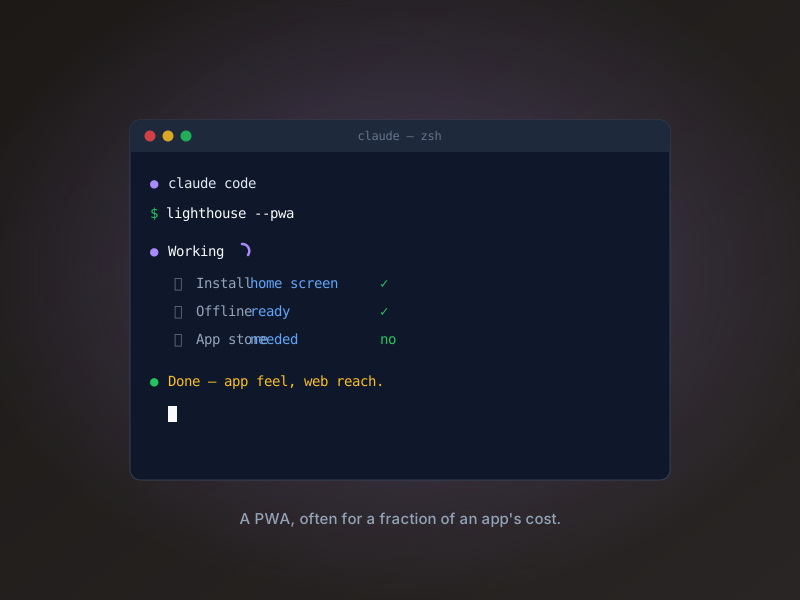
A native app is the thing you download from the App Store or Google Play. It is built specifically for the phone, it gets an icon, and it can reach deep into the device. A progressive web app, or PWA, is a website built so well that it behaves like an app. It installs to the home screen, opens full screen with no browser bar, works offline, and can send notifications. To the person using it, a good PWA and a native app feel almost the same. Under the bonnet they are very different jobs to build and maintain.
Where a PWA wins for most businesses
For the majority of the Hull businesses I work with, a PWA does the job for a fraction of the cost. You build it once and it runs on iPhone, Android, and a laptop from the same code. There is no app store review to wait on, no yearly developer fees to Apple and Google, and when you fix something it is live the moment you deploy it, not whenever a reviewer gets round to approving the update. If what you need is bookings, a shop, a menu, a members area, a loyalty card, or a site that keeps working on a dodgy signal, a PWA covers it. I have written a simpler version of this decision in do you need an app or a PWA if you just want the short answer.
The cost gap is the big one. A native app usually means building for iOS and Android as two separate things, or paying for a framework that does both and still needs testing on real devices. Then you maintain it forever as phones and operating systems change. A PWA is one website. For a small business that is often the difference between a project you can afford and one you keep putting off.
Where a native app genuinely wins
I will not pretend a PWA is always the answer. There are real cases where I tell a client to spend the money on native:
You need hardware a browser cannot fully reach, like Bluetooth devices, advanced camera control, or background location tracking while the app is closed.
You are selling the app itself and need to be found by people browsing the App Store, where a website will never appear.
You need the smoothest possible performance for something heavy, like a game or a serious graphics tool.
Your customers expect to find you on the store, and not being there would look odd for your kind of business.
On the iPhone side there are still a few PWA limits worth knowing. Push notifications work now, but some device features arrive later on Apple than on Android, and a PWA cannot be listed in the App Store. If any of those matter to your plan, that is a point for native, and I will say so.
The question I actually ask
When someone tells me they want an app, I do not start with the technology. I ask what they picture their customer doing with it. Nine times out of ten the answer is book a slot, buy a thing, check something, or get a reminder. All of that a PWA does well. The times the answer involves the phone's hardware, or being found on the store, or a level of polish that has to be perfect, that is when native earns its keep. Start with the job, not the label, and the right choice is usually obvious.
How I would decide if it were my money
If I were spending my own budget as a small business, I would build a PWA first almost every time. It gets you an installable, app-like thing quickly and cheaply, and it tells you whether people actually use it before you sink thousands into a native build. If it takes off and you hit a genuine wall that only native can solve, you go native then, with real usage behind the decision instead of a guess. That order has saved my clients a lot of money that would otherwise have gone on an app nobody downloaded.
If you are weighing this up for your own business and want a straight answer with no sales pitch, that is exactly the kind of thing I talk through on a free 30 minute call. You can see how I approach progressive web apps or just book a surgery and tell me what you are trying to do. I would rather point you at the cheaper option that works than sell you the expensive one that does not.
Free 30-min surgery
Working on something similar?