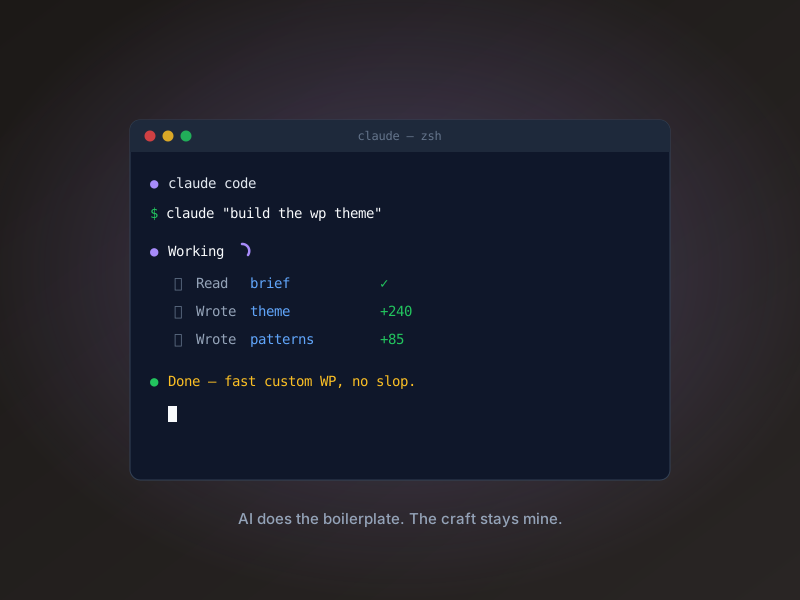
I have been using AI to write code every working day for about two years now. Long enough that the novelty has worn off and I can tell you what actually changed, rather than what I thought was going to change.
Most of what gets written about this is either sales copy or panic. The reality from my desk in Hull is duller and, I think, more useful if you are a business owner trying to work out what it means for you.
What it genuinely changed
The first thing is boring and enormous: the gap between deciding something and having it in front of me got much shorter.
A concrete example. A client wanted a booking form with some awkward rules about when slots could be taken. In 2023 I would have spent most of a day on the first working version, then shown it, then found out I had misread one of the rules. Now I have something running in an hour, they look at it the same afternoon, and we find the misunderstanding on day one rather than day three. The code is not better. The loop is faster, and being wrong quickly is worth more than being slow and careful about the wrong thing.
The second thing is that I stopped avoiding jobs I found tedious. Data migrations, a hundred redirects to write, a big awkward CSV to clean up. Those used to be the tasks I quietly pushed to Friday afternoon. They now take a fraction of the time, which means I stop putting them off, which means clients get them done properly instead of getting a shrug.
Third, and this one surprised me: I read more code than I used to. When you review generated code all day, reading closely becomes the main skill. I am better at picking apart somebody else's WordPress theme now than I was before, purely from practice.
What it did not change at all
Nobody has ever hired me because I can type. They hire me because I can work out what they actually need, which is usually not what they asked for in the first email.
That part is untouched. A client tells me they want a members area. Two questions in it turns out what they want is for six regulars to stop ringing up to ask the same thing, and a decent FAQ page and an email would solve it for a fraction of the money. No tool has an opinion about that. It will happily build the members area, quickly and neatly, and it will be the wrong thing.
Judgement about what to build, what to leave out, and what will still be maintainable in three years when somebody else has to touch it. That is the job. It always was. The typing was never the job.
Where I will not let it near
I have got firm lines, and they come from getting burned rather than from principle.
Anything touching payments or authentication gets written and read line by line by me. Generated auth code looks right far more often than it is right, and that is the worst possible combination.
Database changes on a live site. I will draft the migration with help, then run it myself, on a copy, twice, before it goes anywhere near production.
Anything I could not explain to you. If I cannot tell you what a piece of code does and why it is there, it does not ship. That rule alone catches most of the trouble.
Content. It writes competent, forgettable prose that reads like everybody else's. Your website already sounds like every other website in your trade. It does not need help with that.
The failure mode people warn about is real, by the way. It is confidently wrong. It will produce something that looks completely plausible, runs without an error, and quietly does the wrong thing in a case you did not test. Fifteen years of doing this is what tells me where to look. Somebody starting out today with the same tools and no scar tissue is in genuine trouble, and I do not have a good answer for that.
What it means for what you pay
This is the question I actually get asked, usually sideways, so let me answer it directly.
Some things got cheaper, because they got faster. A straightforward brochure site, a set of custom post types, a migration off a page builder. Those take me less time than they did, and I charge for time, so they cost less.
Some things did not move at all. The half day working out what your site needs to do. The design decisions. The testing on real phones. The conversation where I talk you out of something. That is most of the value in a project, and none of it got faster. I went through the whole reasoning in how I quote a website.
What I will not do is use the speed to churn out more sites and pay less attention to each one. The tools let me spend a bigger share of a project on the parts that need a person. That is the point of them, and it is why I have not put my rates up while working faster.
The short version
AI writes a lot of the code I ship. It has not written a single decision. It made me faster at the mechanical half of the job and left the half that clients actually pay for exactly where it was, which is with a person who has done this long enough to know what goes wrong.
If somebody tells you AI means your website can be built for a few hundred pounds by the weekend, they are describing the typing. The typing was never the expensive bit.
If you want a straight answer about what your site needs and what it would take, book a free 30 minute surgery. No pitch, no obligation, and I will tell you if you do not need me.
One thing to be clear about: this is the freelance web development side of what I do. If you are running an ecommerce platform and thinking about a headless migration or a replatform, that lives over at Headless Digital instead.
Free 30-min surgery
Working on something similar?